









 Our Approach
Our Approach
At the heart of all our media development work are the Reuters Trust Principles of accuracy, impartiality, independence and integrity.
Drawing on the expertise and global footprint of Reuters News, we implement initiatives ranging from the creation of sustainable, independent news platforms to a wide range of skills and editorial programmes. We fund the Reuters Institute for the Study of Journalism at Oxford University, a global research centre producing the indispensable Digital News Report and publications on the current and future trends in journalism.
This unique mix allows us to provide world-class solutions to pressing needs, helping superb journalism reach the largest possible audience.
We believe accurate and independent media lead to better informed societies. It holds power to account and contributes to social and economic development.
We work with partners to make sure that media development is part of wider international development strategies. All our programmes are led by world-class trainers and experts and combine hands-on experience, on-going editorial support, story grants and opportunities for international distribution including over the Reuters News wire.
Examples include:
Training: Hands-on training from Reuters journalists with a focus on producing real stories
Project grants: Funds for specific investigations and cross-border collaborations
Mentoring: Editorial support from idea to publication by Reuters veterans to give stories global resonance
Distribution: Global channels to bring the best journalism to the widest possible audience
Fellowships: Opportunities to broaden horizons through research and exchanges

 Areas of Focus
Areas of Focus
From photojournalism workshops to independent news agencies, we run programmes on every continent tailored to real needs.
 Where we Work
Where we Work
Since 1983 we have worked in over 170 countries around the world, with over 15,000 journalists.
In that time the world has changed dramatically as geo-political boundaries have shifted, economies have swelled and dwindled, and populations have adapted to modern environmental, economic and social realities.
The importance of the news media in reporting these changes has never been more essential, yet the challenges they face are changing all the time too. We help journalists and newsrooms to tackle these issues, wherever they are from.
Our projects vary in scope and scale, from assisting journalists in Zambia or the Philippines to cover national elections, helping Congolese or Jordanian journalists take impactful photographs, or investigating the governance of international aid. We also run regional schemes that work with journalists across a whole continent, such as our Wealth of Nations project in Africa, or the Perspektivy programme in Russian speaking countries.
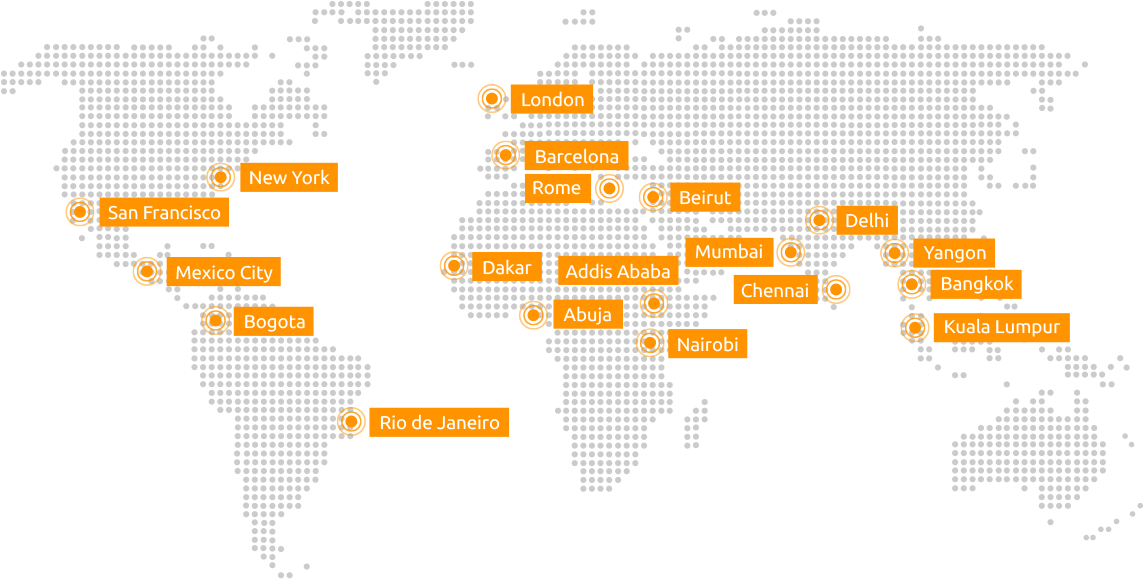
^ Thomson Reuters Foundation Hubs
 Opportunities for Journalists
Opportunities for Journalists
 Reuters Institute
Reuters Institute
The Reuters Institute for the Study of Journalism was established in 2006 with core funding from Thomson Reuters Foundation. It marks the collaborative commitment between the University of Oxford and the Foundation to create an international research centre in the comparative study of journalism.
The Institute aims to serve as the leading forum for engagement between scholars and the practitioners of journalism. It is anchored in the recognition of the key role of independent media in open societies and the power of information in the modern world.
Core Institute activities include the Journalism Fellowship Programme which brings high calibre mid-career journalists to Oxford offering them a period of reflection and the opportunity to carry out media-based research and publish their findings.
 Our News
Our News
 Our Resources
Our Resources
Guides & Handbooks
Visit our publications library for guides, handbooks and tip sheets on everything from ethics in journalism to covering elections, reporting on business and finance or covering the Olympics and major sporting events.
See all Guides
Featured
Oil and Gas Reporting Handbook by Nick Phythian
This handbook offers advice and guidance to journalists reporting on the oil and gas industry.
ViewTips & Tricks
Our text and video tips give you insider knowledge from award-winning Reuters journalists and top editors on topics as diverse as photojournalism, covering Ebola and health scares to how to plan an investigative mission.
Featured
Seven photojournalism tips by Reuters photographer Damir Sagolj
How to shoot great news photography? This video by award-winning Reuters photographer Damir Sagolj gives his seven top tips on how to engage audiences and tell a great visual story.
View